Research
|
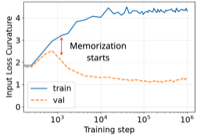
Loss Curvature as a Sampling-Free Proxy for Memorization in Diffusion ModelsShashank Sule, Xinyue Yu, Boonam Shin, Yuxuan Liu, Abolfazl Hashemi, Hayden SchaefferarXiv, 2026 arXiv / We identify curvature of a diffusion model’s loss function as an important proxy for measuring two types of memorization in diffusion models: (a) sample-level memorization that concerns an individual sample’s propensity for being memorized, and (b) model-level memorization that describes whether a diffusion model’s score structurally regurgitates the training data.... |
|
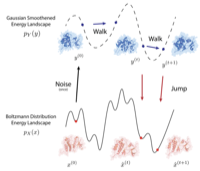
Boltz-Jump: Accelerated Sampling of the Conformational Landscape of Biomolecular Structure Prediction ModelsAmeya Daigavane, Shashank Sule, Saeed Saremi, Andrew Martin Watkins, Joseph Kleinhenz, Tess Smidt, Bodhi P. Vani2026 Workshop on Generative and Agentic AI for Biology, 2026 paper / arXiv / We perform walk jump sampling with the diffusion trunk in Boltz2, a highly popular open source structure prediction model. In particular, by annealing at a moderately large fixed temperature, we are able to repurpose this diffusion trunk into a fast stationary sampler, followed by one-step denoising to produce a fast... |
|
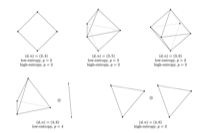
Neural collapse in the orthoplex regimeJames Alcala, Rayna Andreeva, Vladimir A. Kobzar, Dustin G. Mixon, Sanghoon Na, Shashank Sule, Yangxinyu Xie.arXiv, 2026 arXiv / Neural collapse is a phenomenon in deep learning where features of a classifier converge to the vertices of a simplex as training progresses. We studied this phenomenon where the number of classes exceeds the dimension. |
|
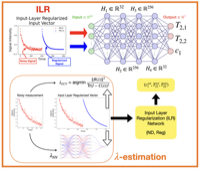
Input layer regularization and automated regularization hyperparameter tuning for myelin water estimation using deep learningMirage Modi, Shashank Sule, Jonathan Palumbo, Michael Rozowski, Griffin S. Hampton, Mustapha Bouhrara, Wojciech Czaja, Richard G. Spencer.NMR in Biomedicine, 2026 paper / arXiv / code / We study how much information classical statistical estimators hold about underlying random variables in myelin water imaging, and show that input layer regularization with automated hyperparameter tuning can outperform copious deep learning alone. |
|
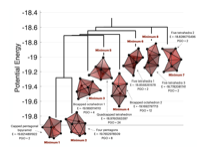
Learning collective variables that respect permutational symmetryJiaxin Yuan, Shashank Sule, Yeuk Yim Lam, Maria Cameron.Journal of Chemical Physics, 2025 paper / arXiv / We propose algorithms for learning collective variables that respect permutational symmetry, with case studies on Lennard-Jones clusters using quantitative coarse-graining theory and tools from geometric data science. |
|
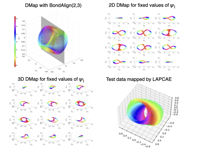
Learning collective variables that preserve transition ratesShashank Sule, Arnav Mehta, Maria Cameron.SIAM Multiscale Modeling and Simulation, 2025 paper / arXiv / code / We turn Legoll and Lelievre’s quantitative coarse-graining theory into an algorithm for learning collective variables that preserve transition rates in molecular systems, with a case study on butane. |
|
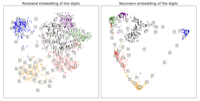
Neumann eigenmaps for landmark embeddingShashank Sule, Wojciech Czaja.Sampling Theory and Applications (Oral), 2025 paper / arXiv / We propose a new dimensionality reduction technique termed Neumann eigenmaps which uses landmarks to enhance standard spectral embedddings, while preserving an isometry property of diffusion maps. |
|
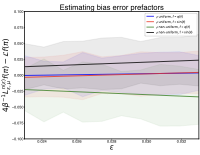
Sharp estimates for target measure diffusion maps and applications to the committor problemShashank Sule, Luke Evans, Maria Cameron.Applied and Computational Harmonic Analysis, 2025 paper / arXiv / We leverage the approximation theory of target measure diffusion maps to obtain sharp error estimates with explicit prefactors, yielding concrete accuracy gains for rare-event quantification via the committor problem in molecular dynamics. |
|
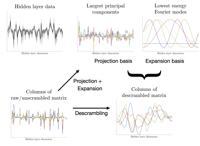
On the limits of neural network explainability via descramblingShashank Sule, Richard G. Spencer, Wojciech Czaja.Applied and Computational Harmonic Analysis, 2025 paper / arXiv / We study fundamental limits on explaining neural network decisions through descrambling methods, identifying when such approaches can and cannot recover meaningful structure from learned representations. |
|
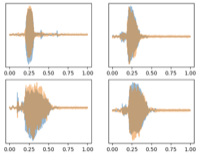
Neural network-based speech reconstruction from undersampled STFT magnitude dataWojciech Czaja, Matthias Wellershoff, Shashank Sule, Canran Ji.EUSIPCO 2024, 2024 We show that neural networks can reconstruct speech from undersampled Short Time Fourier Transform magnitude measurements, recovering phase information from far fewer samples than classical methods require. |
|
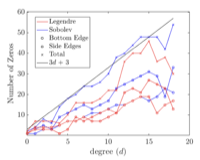
Sobolev Orthogonal Polynomials on the Sierpinski GasketQingxuan Jiang, Tian Lan, Kasso Okoudjou, Robert Strichartz, Shashank Sule, Sreeram Venkat.J. Fourier Analysis and Appl., 2021 arXiv / code / We construct and analyze Sobolev orthogonal polynomials on the Sierpinski gasket, extending classical orthogonal polynomial theory to fractal domains. |